The History of The Paris Catacombs

Earlier this year Alan and I were lucky enough to go to Paris and visit the infamous Catacombs. It didn’t surprise me that it was a claustrophobic experience, but it did surprise me how emotional it was. For me, it was the opposite of visiting a cemetery (which I do often.) Instead of a stone with someone’s name, a symbol of the life they lived, the Paris Catacombs are filled with millions of unmarked bones. It made me feel incredibly aware of my mortality.
For more on our experiences, listen to episode 193 of the Lunatics Radio Hour podcast.
The underground ossuary known today as the Paris Catacombs is perhaps one of the most famous mass graves in the world. An ossuary is a place where human skeletal remains are respectfully stored or deposited, some have compared an ossuary to a “bone archive” instead of a burial ground. There are no individual graces, instead bones are usually moved there after bodies have decomposed elsewhere, often because space is limited in cemeteries or burial sites. The remains are then collected and arranged, sometimes in stacks, walls, or decorative patterns, depending on cultural practice. The word comes from the Latin ossuarium, meaning “container of bones.”
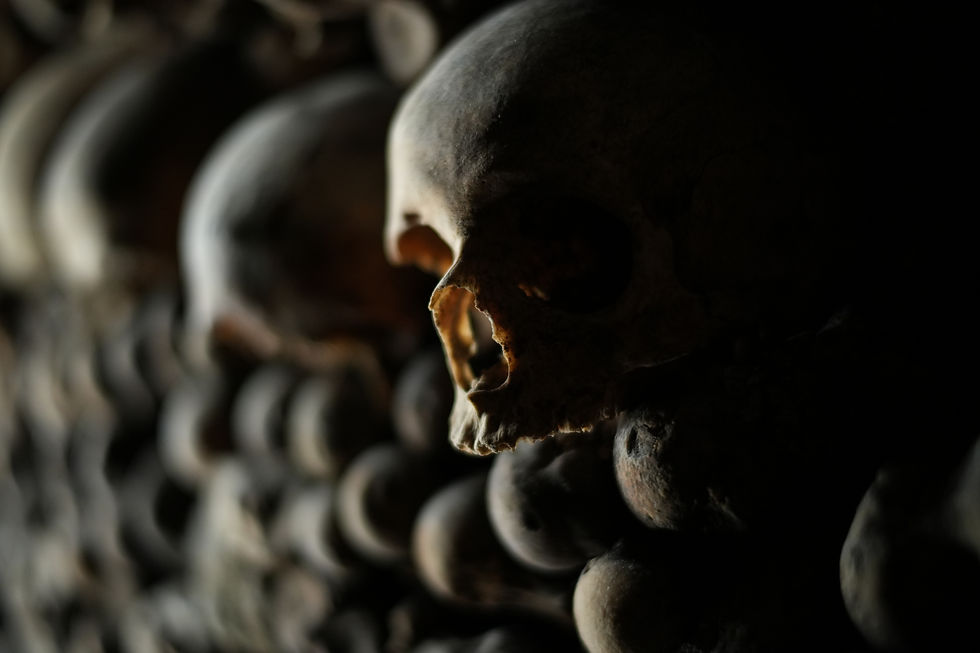
The Paris Catacombs sit beneath the modern city of Paris, the catacombs represent one of the most extensive and unusual responses to mortuary overcrowding in European history. From the medieval period onward, Paris relied heavily on limestone extracted from underground quarries to build its churches, bridges, and civic architecture. Over time, this extraction produced a vast network of tunnels beneath the city. By the 18th century, these abandoned quarries extended for hundreds of kilometers, largely unregulated and structurally unstable in places.
As Paris expanded in size, the city gradually became dependent on the tunnel system below, which was poorly mapped and only partially maintained. This latent infrastructure would later become central to one of the city’s most urgent crises. By the late 1700s, Paris faced severe public health issues linked to its burial practices. Churches and urban cemeteries, particularly the Cemetery of the Innocents, had been used continuously for centuries.

The Cemetery of the Innocents was one of the oldest and most significant burial grounds in medieval and early modern Paris, located near the central market district of Les Halles. It was in use for nearly a thousand years, and it became the primary burial site for ordinary Parisians, which over time led to extreme overcrowding. By the 18th century, the cemetery had been used so extensively that graves were repeatedly reused, mass burials were common, and bones were periodically exhumed and transferred to make room for new interments. The site became notorious not only for its density but also for the public health concerns associated with decomposition in such a tightly packed urban environment.
Contemporary accounts describe significant sanitation concerns. Decomposition produced strong odors and contaminated surrounding soil and water sources. Structural failures were also reported, including the collapse of cemetery walls that exposed decomposing remains into adjacent properties. While some of these accounts were later exaggerated, there is consensus among historians that the conditions created legitimate public health anxiety within densely populated districts.
The crisis reached a tipping point in 1780, when a retaining wall at the Cemetery of the Innocents collapsed, releasing decomposed remains into nearby buildings. This event intensified calls for reform in burial practices and prompted the Parisian authorities to consider alternative solutions. The formal relocation of remains began in 1786 under the authority of the Paris police and the Inspection Générale des Carrières (General Inspection of Quarries). The objective was not only to address overcrowded cemeteries but also to repurpose unstable underground spaces into controlled infrastructure.
Remains were transferred primarily at night in covered carts, often accompanied by clergy performing rites of consecration. Over time, bones from multiple cemeteries across Paris were systematically relocated into sections of the former quarry network. The scale of this transfer was extraordinary.

Historians estimate that the remains of approximately six million individuals were eventually moved into the ossuary. However, it is important to note that these figures are approximate, as records from the period were incomplete and often inconsistent. Initially, the transferred bones were deposited in a relatively disorganized manner. However, during the early 19th century, significant efforts were made to reorganize the ossuary space.
A key figure in this process was Héricart de Thury, who oversaw reforms in the early 1800s. Under his direction, the catacombs were not merely a storage site but were structured into a deliberately arranged environment. Bones were stacked in patterned walls, and architectural features were introduced to stabilize the tunnels and formalize visitor pathways.
During the French Revolution, the catacombs gained additional symbolic significance. Although not originally designed for political purposes, the subterranean network intersected with revolutionary narratives of equality in death, as individuals from different social classes were ultimately interred in the same space.
In the 20th century, particularly during the Second World War, sections of the underground tunnels were used for strategic purposes. The French Resistance is known to have operated within parts of the subterranean network, utilizing its complexity for concealment and movement. German forces also occupied certain underground structures during the Paris occupation.
These uses reinforced the catacombs as not only a mortuary site but also a functional urban labyrinth with strategic importance.
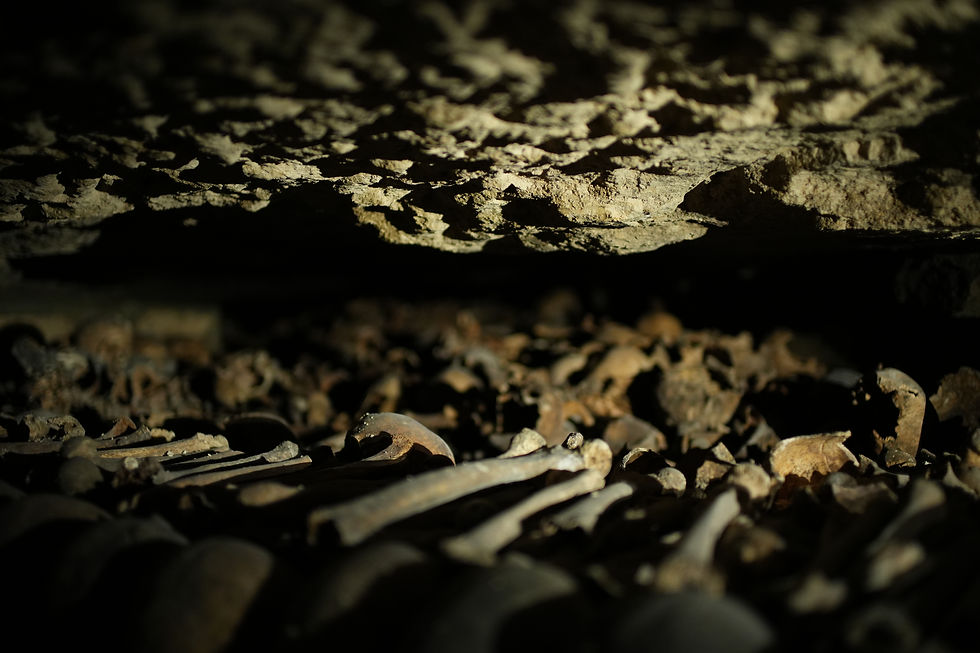
During the early to mid-1800s, the catacombs also became something of a controlled curiosity site. Members of Parisian high society, intellectuals, and foreign visitors were sometimes granted permission to enter the tunnels with guides. These visits could feel theatrical, but they were still regulated and formal. Some accounts describe small groups walking through lantern-lit passages, but again, these were structured tours rather than celebrations or underground parties.
There is also a broader misconception that the catacombs were used for secret social events throughout the 1800s. In reality, most of the documented underground “social life” tied to parties, secret clubs, and unauthorized gatherings developed much later, mainly in the 20th century, when access control weakened and urban exploration culture emerged.
But the official Catacombs tour does reference some seemingly unsanctioned parties from the 1800s. Stories about break-ins into the Paris Catacombs are mostly tied to a subculture of underground explorers known as cataphiles, who access the restricted tunnel network beneath Paris through maintenance shafts, sewer openings, or hidden quarry entrances. While not officially sanctioned, this activity has persisted for decades and has produced a mix of documented incidents and well-known urban legends.

One recurring theme is underground parties. Reports from the late 20th century onward describe groups setting up temporary events deep in the tunnels, sometimes with sound systems, lighting, and even improvised bars. Getting equipment in is difficult, so these events are usually small and carefully planned. Attendees navigate using informal maps or markings left by previous visitors. Police raids have occasionally uncovered these setups, especially when noise or surface activity led to discovery.
Another strand of report involves more organized gatherings that resemble secret clubs or societies. These are often described as invitation-only groups rather than formal organizations. Meetings might involve art projects, screenings, or discussions held in hidden chambers. In some cases, explorers have reportedly built semi-permanent spaces underground, including seating areas or projection setups, which are later dismantled or abandoned when authorities find them or access routes are sealed.
There are also accounts of concerts held in larger quarry chambers, where musicians perform for small groups. The acoustics in limestone tunnels can amplify sound significantly, which makes even simple performances feel larger and more intense. However, these events are risky and illegal, and access routes are often changed or blocked once discovered. Because the underground network is so extensive and partially unmapped, it’s difficult to know how often these gatherings still happen, but they remain a consistent part of the modern mythology surrounding the catacombs.
Of course there are urban legends and folklore linked to the Catacombs. Most of these stories come from the size of the tunnel system and how little of it is accessible or fully mapped.One common set of stories involves people getting lost in the underground quarries. The network extends for hundreds of kilometers, and only a small section is open to the public. There are documented cases of people entering restricted areas and becoming disoriented, sometimes requiring rescue. Urban legends expand this into claims that people disappear permanently or that bodies are never recovered, though confirmed cases of permanent disappearance are not supported by reliable records.

Another group of legends concerns unauthorized occupation of the tunnels. Over time, there have been reports of people entering restricted areas to explore or spend time underground. In a few documented cases, authorities have found temporary setups such as seating areas, lighting systems, or improvised rooms. These findings have led to exaggerated stories about permanent underground communities living in the catacombs, but there is no verified evidence of long-term settlements.
There are also supernatural claims associated with the catacombs, such as ghosts or unexplained sounds. These are not supported by evidence and are generally explained by environmental factors like echoing acoustics, low visibility, and psychological effects of confined underground spaces.
Finally, there are legends about secret societies using the tunnels for meetings or rituals. While informal exploration groups and unauthorized entry are real, there is no confirmed evidence of organized long-term secret societies operating underground. These stories persist mainly because the tunnel system is large, complex, and partially restricted, which makes it difficult to verify everything that happens within it.
As Above, So Below (2014) is the most well-known modern horror film set directly in the catacombs. The story follows a group of explorers and academics who enter the tunnels searching for the Philosopher’s Stone. As they go deeper, the layout becomes increasingly disorienting and hallucinatory. The film uses the real restricted sections of the catacombs and emphasizes claustrophobia, darkness, and psychological breakdown as the group loses orientation underground.
Another film worth mentioning is Catacombs (2007), this horror film centers on a young woman who visits Paris and is invited to a secret rave held in the underground tunnel network. After becoming separated from the group, she becomes lost in the catacombs and is pursued by an unknown figure. The film plays on the idea of illegal parties in restricted underground spaces, though it takes significant creative liberties with the actual layout and conditions of the tunnels.
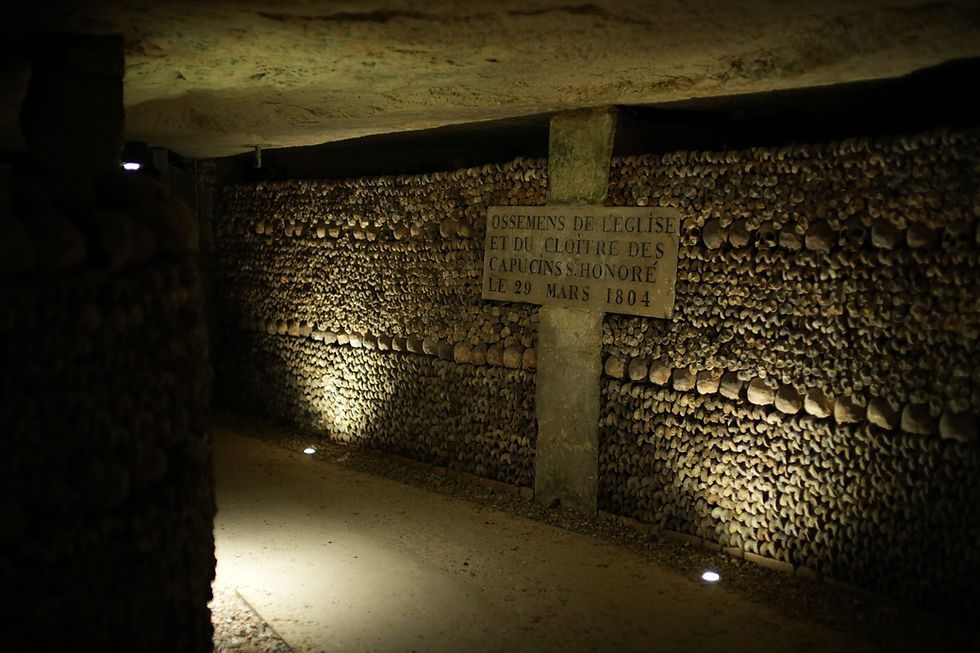
Today, the catacombs are a controlled heritage site and one of Paris’s most visited historical attractions. Only a small portion of the tunnel system is open to the public, yet this limited section provides insight into a much larger and largely inaccessible subterranean world.
The catacombs continue to raise questions about urban planning, memory, and the management of death in modern societies. Unlike traditional cemeteries, which separate the living from the dead geographically, the catacombs place mortality directly beneath the city’s daily life. This spatial relationship creates a unique form of historical continuity, in which modern Paris literally rests atop the physical remains of its earlier population.
The history of the Paris Catacombs is ultimately a story of adaptation. What began as a network of limestone quarries evolved into a solution for a public health crisis and eventually into a carefully organized ossuary containing millions of human remains. Over time, it has also become a cultural and historical artifact that reflects changing attitudes toward death, urban space, and collective memory.
Rather than existing as a curiosity beneath the city of Paris, the catacombs function as a structural reminder that urban life is built upon layers of forgotten history—both literal and human.
Sources
The official website of the Catacombs and our visit
Paris Unlocked article: History of The Paris Catacombs by Courtney Traub
Culture Veuz article by Antione Vitek: The Unusual History of The Paris Catacombs
History.com article The Dark Origins of The Paris Catacombs by Jessica Pearce Rotondi
For more on our experiences, listen to episode 193 of the Lunatics Radio Hour podcast.


